Petra Visitor Guide: Tickets, Trails, Timing and What to See
Plan a confident, well-paced visit to Petra with practical advice on tickets, the Siq, Treasury, Royal Tombs, Monastery trails, Little Petra, weather, water, footwear, photography, accessibility and transport. Learn how to choose realistic routes and make the most of your time inside Jordan’s extraordinary archaeological city.
Start with a realistic plan for Petra
A good Petra visit is less about ticking off monuments than managing energy, daylight and distance. The archaeological park is large, the main route is not a short stroll and the most memorable places often require sustained walking on uneven stone, packed earth and long flights of steps. This Petra visitor guide is designed to help you decide what to see, how to pace the day and where to focus if time or mobility is limited.
Petra is reached through Wadi Musa, the modern town immediately beside the visitor area. Most travellers arrive from Amman, the Dead Sea, Aqaba or Wadi Rum, then spend at least one night nearby. Arriving the evening before a full day in Petra is usually far more comfortable than attempting the site directly after a long road journey. It gives you time to settle in, buy water and snacks, check the weather and start early while the temperatures and crowds are generally more manageable.
For travellers based in the capital, a Petra day trip from Amman with private transport can be a practical option when time is very limited, although it makes for a long day and leaves less room for the longer trails. A private driver from Amman to Petra is often a better fit for visitors who want to stay overnight in Wadi Musa, begin early the next morning and travel at their own pace.
Before travelling, check the official Petra visitor information for current admission arrangements, opening times, trail notices, weather-related restrictions and any requirements that may apply to your visit. These details can change seasonally and in response to conditions in the park.
Understanding Petra’s layout
Petra is not one monument. It is a vast Nabataean city and archaeological landscape of tombs, temples, streets, water systems and high places carved into or built among sandstone mountains. The best-known image, Al-Khazneh or the Treasury, is only an early stop on the principal approach. Beyond it, the valley opens into the Street of Facades, the Theatre, the Royal Tombs, the Colonnaded Street, Qasr al-Bint and the routes toward the Monastery and the High Place of Sacrifice.
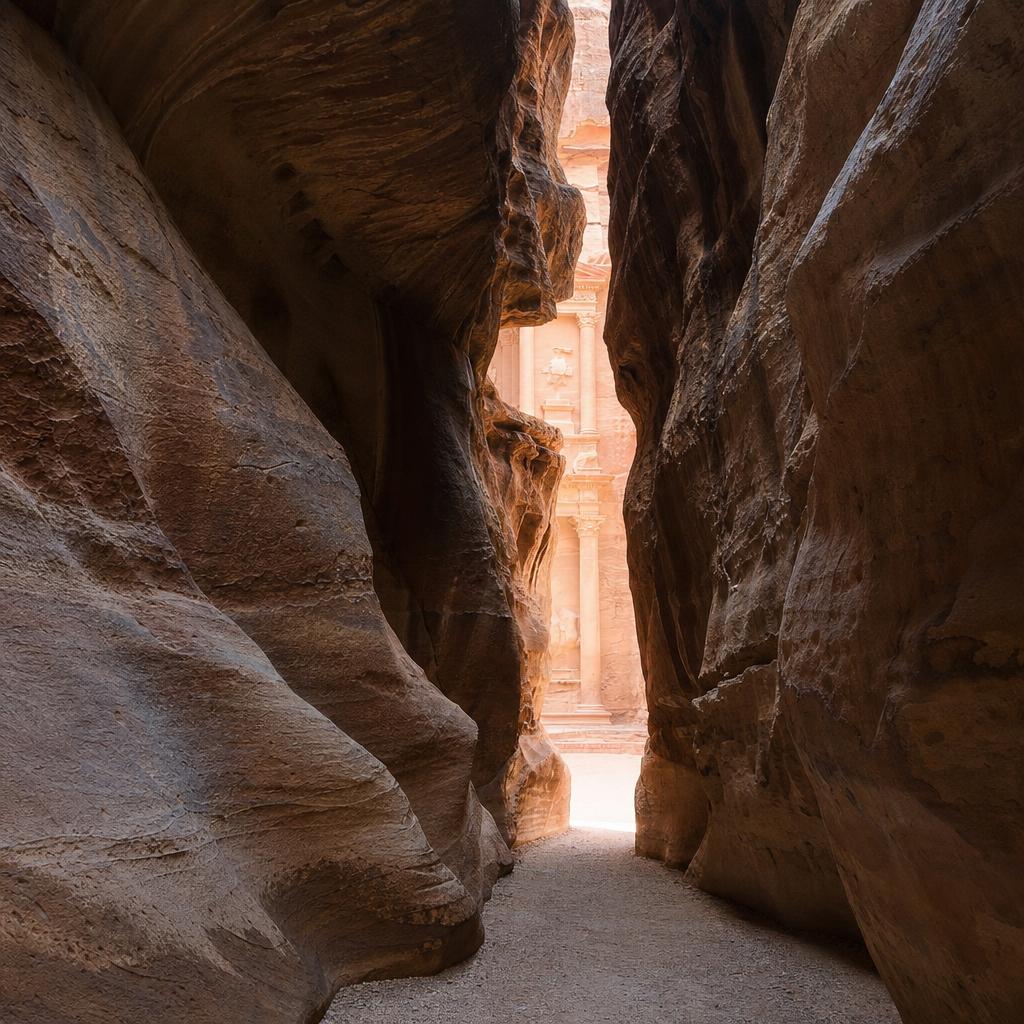
The standard entrance is at the visitor centre on the edge of Wadi Musa. From there, the route drops gradually through the broad Bab al-Siq area before narrowing into the Siq, a dramatic natural sandstone gorge. The Siq leads to the Treasury, after which the route continues into the central basin of Petra.
It helps to think of the site in zones:
- The entrance, Bab al-Siq and Siq: a long approach through open terrain and then the gorge.
- The Treasury and Street of Facades: the iconic first reveal and a concentrated group of tomb façades.
- The central city: the Theatre, Royal Tombs, Great Temple area, Colonnaded Street and Qasr al-Bint.
- The high trails: the Monastery route, the High Place of Sacrifice route and other signed paths.
- Little Petra: a separate archaeological area outside the main entrance, usually visited by road rather than on foot from central Petra.
Distances can be deceptive. A map may make a route look straightforward, but climbs, loose surfaces, heat and photo stops slow almost everyone down. Build in time for rest rather than planning every hour too tightly.
Tickets, entry and arriving at the visitor centre
Ticket and entry procedures are important to check shortly before your visit. Petra’s official channels are the right place to confirm current ticket categories, identification requirements, payment methods, opening periods and whether any special programmes are operating. Do not rely on old blog posts for prices or opening times.
Aim to arrive with enough margin before you want to start walking. The visitor area can be busy at popular times and a rushed start tends to create problems later when you are trying to fit in a long trail. Have your passport or relevant identification available if required and keep your ticket safely stored for the day. If you are travelling with children, older relatives or anyone with a medical condition, use the visitor centre stage to agree on a turnaround point and a meeting plan.
There are services around the visitor centre and in Wadi Musa, but do not assume that every item will be available once you are deep inside the archaeological park. Carry what you need for several hours: water, sun protection, a light layer and any personal medication. Small purchases may be possible along main routes, but availability and payment options should not be the foundation of your plan.
Petra is a protected heritage site, not an outdoor mall. Respect barriers, do not climb on monuments, and do not enter restricted spaces. The sandstone is fragile, and seemingly small actions contribute to erosion. A visit is better when it is approached as time in a living archaeological landscape rather than a race between photo locations.
The Siq: how to experience the approach properly
The Siq is one of Petra’s essential experiences. Its tall, twisting walls frame a route once used by caravans arriving in the Nabataean capital. As you walk, look beyond the rock formations. Sections of ancient water channels run along the walls, evidence of the sophisticated systems that brought water into the city. The surface may be uneven and the gorge can feel cool or shaded compared with the open valley, but it is still important to watch your footing.
The approach to the Treasury is most powerful when you allow it to unfold slowly. The façade appears through a narrow opening near the end of the Siq and stopping briefly to take in the scale is worthwhile. This is also one of the most congested points in Petra. Be patient with other visitors, avoid blocking the path for prolonged photography and keep an eye on children in the crowd.
Animal rides may be offered in or around the site. Anyone considering one should make an independent, informed decision, observe animal condition carefully and avoid feeling pressured by sales approaches. Walking gives the clearest sense of the geography, but it is sensible to assess your own mobility and stamina honestly. Official visitor staff can provide current information about authorised transport options and access arrangements.
The Siq is also a reminder that Petra’s landscape is shaped by water. Heavy rain can affect routes in and around the site. If rain is forecast, monitor official guidance, follow instructions from park authorities and never disregard a closure or warning. Desert scenery does not mean weather hazards should be taken lightly.
The Treasury and the first monuments beyond it
The Treasury is one of the most photographed façades in the world, yet it rewards close observation. Look at the composition: columns, pediments, sculptural details and the rose-coloured sandstone surface changing with the light. The monument’s popular name is linked to a local story that treasure was hidden in the urn at its top, but it was built as a monumental tomb or memorial rather than a treasury in the modern sense.
Photography here is best approached with patience. Early and later parts of the day may offer a softer feel, while direct light can make contrasts severe. Rather than chasing a single “perfect” image, take wide views that show the setting, then close details of weathered stone. Keep people and animals out of your frame only where practical; Petra is an active visitor site, and the human scale can help convey its size.
Beyond the Treasury, the valley begins to open. The Street of Facades contains a row of rock-cut tombs, while the Theatre is carved into the hillside nearby. This is a good area to slow down because many visitors hurry past it on the way to the Monastery. The variety of façade shapes reveals how Petra developed over time, blending Nabataean traditions with Hellenistic and Roman architectural influences.
If you have only a few hours, the Treasury, Street of Facades, Theatre and a walk into the central city make a worthwhile core itinerary. Trying to force the Monastery and High Place of Sacrifice into a short visit can turn a meaningful day into an exhausting one.
The main trail through the central city
The main route beyond the Treasury leads through the heart of Petra. It is the most logical choice for a first visit because it connects many of the major monuments without requiring a technical hike. Even so, it is a substantial walk, especially when combined with the return journey through the Siq.
Key sights along and near this route include:
- The Street of Facades, with its sequence of tombs cut into the sandstone.
- The Theatre, originally built by the Nabataeans and later modified under Roman rule.
- The Royal Tombs, high on the slope above the central valley.
- The Nymphaeum area and the start of the Colonnaded Street.
- The Great Temple complex, a major area for understanding Petra as an urban centre.
- The Colonnaded Street, which leads toward Qasr al-Bint.
- Qasr al-Bint, one of Petra’s most significant freestanding monumental structures.
The central basin is where you can see Petra as a city rather than simply a collection of carved façades. Notice the relationship between tombs on the hillsides and civic or religious structures on the valley floor. The Nabataeans chose this setting for strategic, commercial and environmental reasons and their water management made a settlement possible in an arid landscape.
Allow time to pause in the shade where available and to look back toward the Royal Tombs. These changing perspectives are part of Petra’s appeal. The view from the main trail is different in the morning and afternoon as light moves across the rock.
Royal Tombs: a rewarding detour with a climb
The Royal Tombs rise above the main route and are among Petra’s most impressive groupings. They include several large façades, commonly identified as the Urn Tomb, Silk Tomb, Corinthian Tomb and Palace Tomb. Their colours, especially after changing light or when the sandstone is softly illuminated, can be remarkable.
Reaching them involves an uphill detour, so they are often best visited before the day’s heat intensifies or when you have decided not to continue as far as the Monastery. The ascent is not necessarily difficult for an experienced walker, but uneven steps and exposed areas call for care. If your knees are sensitive, a trekking pole can be useful; if you use one, ensure it does not inconvenience others on narrow paths.
The Royal Tombs are particularly valuable for visitors who want a big visual reward without committing to the far longer climb to Ad Deir. They also offer elevated views over the central valley. Treat them as a destination in their own right, not just a photo stop. Take time to inspect the façade details and the way natural erosion has altered the stone.
The Monastery trail: when it is worth the effort
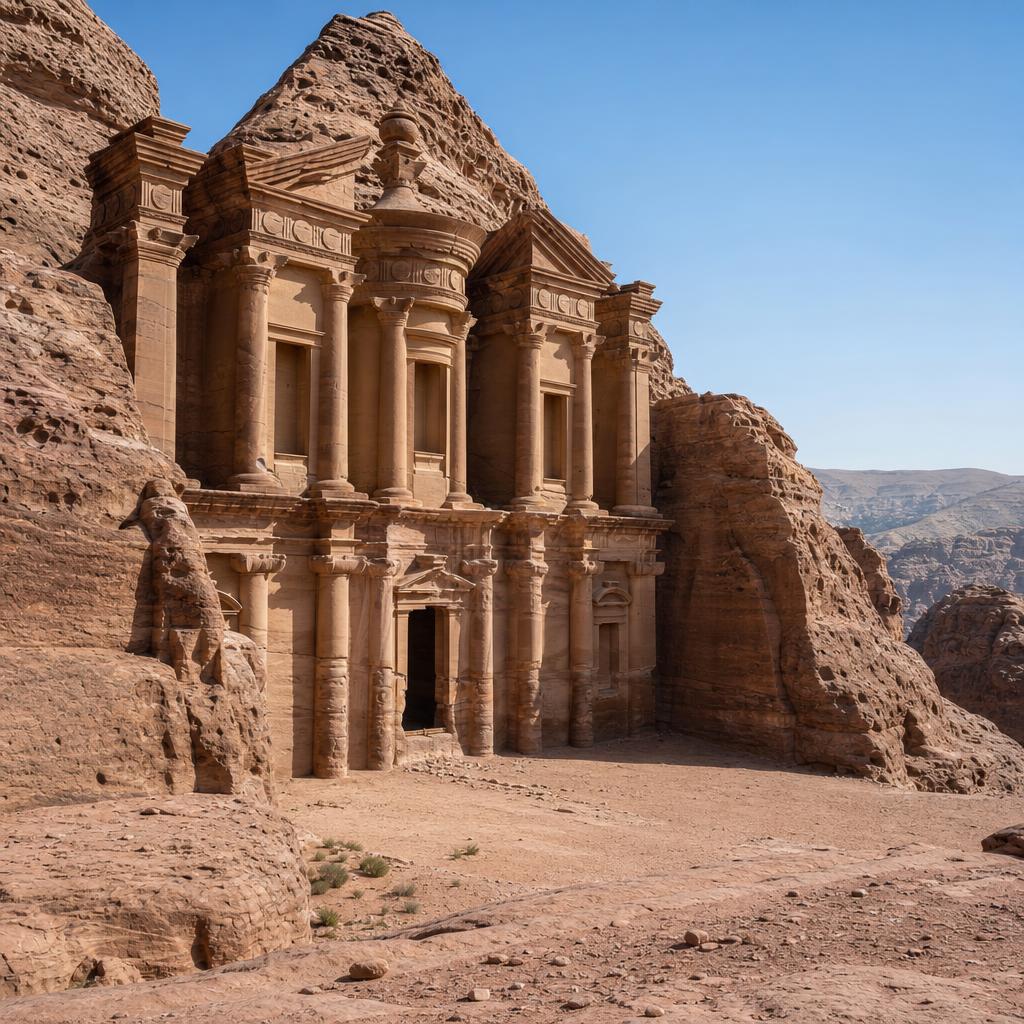
Ad Deir, known as the Monastery, is one of Petra’s grandest monuments. Its façade is broader and simpler in overall composition than the Treasury and its position high in the mountains gives the journey a very different character. For many visitors, it becomes the highlight of a full day.
The route to the Monastery involves a long, sustained ascent over many steps. The exact experience depends on your fitness, heat tolerance, pace and the condition of the trail. It is not a route to attempt casually in sandals, with minimal water or late in the day when you are already tired. Start only if you have enough daylight for the climb, time at the top and a controlled descent.
A sensible Monastery plan includes:
- Starting the climb with water remaining, rather than finishing your last bottle at Qasr al-Bint.
- Wearing shoes with reliable grip and support.
- Taking short rests before you are exhausted.
- Keeping a light layer for wind or cooler conditions at higher elevation.
- Turning back if you feel dizzy, unwell or unable to descend safely.
- Avoiding pressure to keep pace with faster companions.
The trail is often busiest at predictable parts of the day, but conditions vary by season. If your priority is photography, ask official staff or a licensed local guide about current trail conditions and the most suitable time for your visit rather than relying on fixed advice online.
At the top, do not rush away after seeing the façade. The surrounding plateau and viewpoints help explain why this part of Petra feels more remote. Some paths continue farther into the hills, but only use clearly permitted and suitable routes. Never follow unofficial shortcuts, especially near exposed edges or in changing weather.
The High Place of Sacrifice and other viewpoints
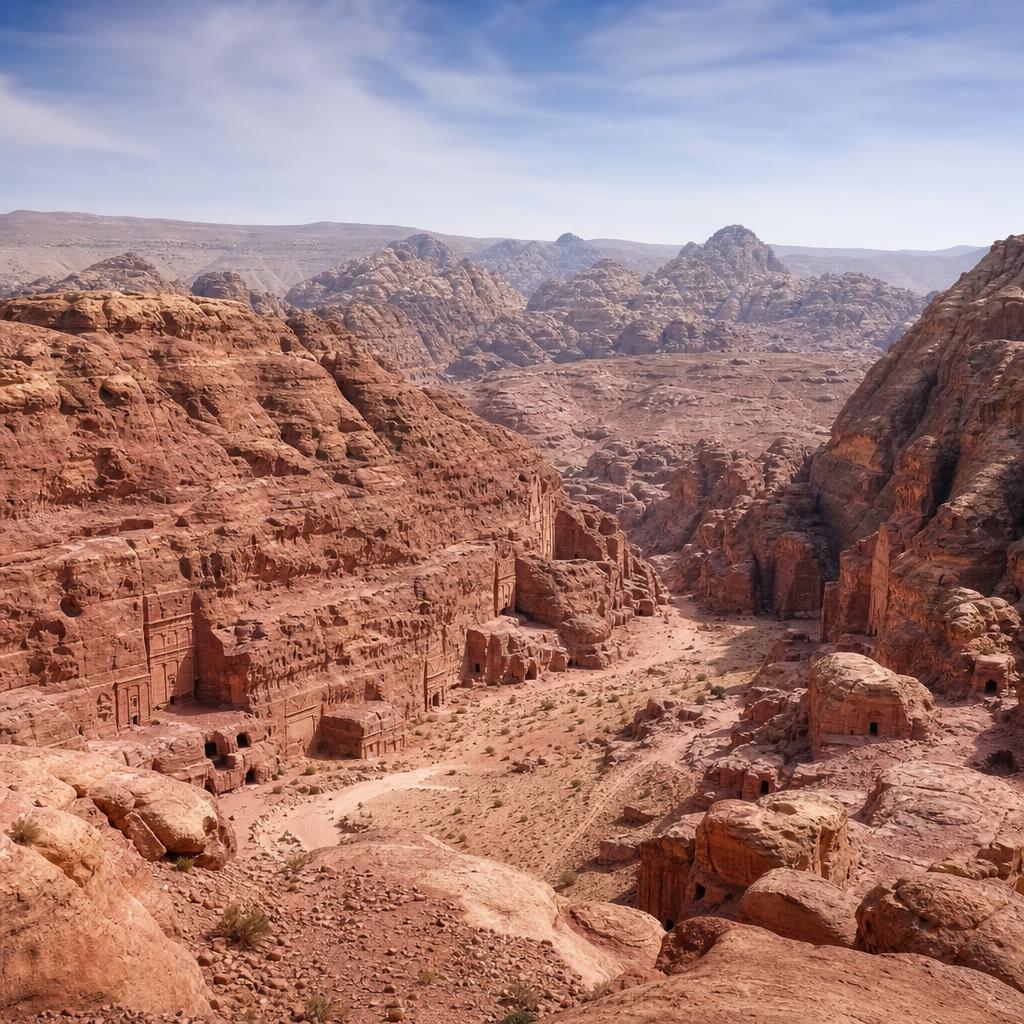
The High Place of Sacrifice is another major Petra trail, known for its elevated setting, ceremonial remains and extensive views over the mountains and city. It is a different experience from the Monastery route: more exposed, more directly tied to Petra’s ritual landscape and often best suited to travellers who enjoy hiking and have a full day available.
This route should be treated as a hike, not an add-on between lunch and sunset. Conditions can change quickly with heat, wind and rain. Choose it when you have proper footwear, enough water, a reliable understanding of the route and the confidence to handle long stone stairways. If you are uncertain, a licensed guide can add useful archaeological context as well as route awareness; confirm independently what any guide service includes before booking.
Petra has several famous viewpoint labels promoted informally around the site. Be selective. The best viewpoint is not necessarily the one with the most dramatic social-media angle; it is one you can reach safely and respectfully, without entering restricted terrain or supporting unsafe practices. Officially recognised paths and staff advice should guide your decisions.
A useful principle is to choose one significant climb per day. Combining the Monastery, High Place of Sacrifice, Royal Tombs, the full main trail and Little Petra in one day is possible only for a small number of very fit, well-prepared visitors and even then it can leave little time to appreciate the archaeology.
Little Petra: how it fits into a Petra itinerary
Little Petra, also called Siq al-Barid, is a smaller Nabataean site northwest of the main Petra entrance. It has a narrow passage, carved façades and spaces that help broaden an understanding of the wider Petra region. It is not a substitute for the main archaeological park, but it is a worthwhile addition for visitors with a second day, an early arrival in Wadi Musa or a transfer that can incorporate it comfortably.
Because Little Petra is reached separately by road, transport planning matters. Discuss the sequence with your driver before the day begins, including waiting arrangements and the time you expect to spend there. The site can be paired with travel onward toward Wadi Rum, but do not assume every itinerary includes stops, guides or activities unless they are explicitly listed.
Visitors continuing south may find a Petra and Wadi Rum private journey useful for joining two of Jordan’s defining landscapes with an organised road plan. If you already have accommodation and activities arranged independently in the desert, a private transfer from Petra to Wadi Rum can keep the travel day straightforward.
Little Petra is quieter in atmosphere than the main site, but it still deserves the same care: stay on appropriate paths, do not climb on carvings and carry out any rubbish. Its smaller scale makes it especially enjoyable when you have time to look at details rather than treating it as a rushed detour.
How much time to spend inside Petra
One full day is enough to see the main route and make a considered choice between major climbs, but two days is better for many travellers. A two-day visit allows you to separate the central city from the Monastery or High Place of Sacrifice, revisit the Siq and Treasury in different light and include Little Petra without exhaustion.
A practical one-day outline might be:
- Begin at the visitor centre early, after checking official current access information.
- Walk through Bab al-Siq and the Siq without rushing.
- Spend time at the Treasury, Street of Facades and Theatre.
- Continue through the central city and choose either the Royal Tombs or the Monastery, depending on fitness and time.
- Return with adequate daylight and energy in reserve.
A more relaxed two-day approach might be:
- Day one: Siq, Treasury, Street of Facades, Theatre, Royal Tombs and the central city.
- Day two: Monastery trail or High Place of Sacrifice, plus Little Petra if transport and timing allow.
The right plan depends on your interests. Archaeology-minded visitors may spend longer around the Great Temple, Qasr al-Bint and tomb complexes. Keen walkers may prioritise a high trail. Families may focus on the Siq, Treasury and main valley. There is no failure in seeing less; Petra rewards attention more than speed.
For a broader road itinerary, a Petra route via the King’s Road can suit travellers who want to connect the destination with Jordan’s historic landscapes en route. Visitors planning an overnight desert extension can also review this two-day Petra and Wadi Rum experience, checking the current page carefully for exactly what is and is not included.
Footwear, water and what to carry
The most useful Petra packing list is simple and practical. You do not need specialist expedition equipment for the main trail, but you do need to be comfortable walking for hours on irregular ground.
Wear closed, broken-in walking shoes or trail shoes with grip. Supportive trainers can work for the main route if they are already comfortable, but smooth-soled fashion shoes, flimsy sandals and brand-new footwear are poor choices. For the Monastery, High Place of Sacrifice or longer trails, sturdier footwear is strongly advisable.
Carry:
- More water than you think you will need for a long walking day, adjusted for weather and your own needs.
- A refillable bottle where practical, plus any preferred electrolyte option.
- Sun protection: hat, sunglasses and sunscreen.
- A light long-sleeved layer for sun coverage or changing temperatures.
- Small snacks that tolerate heat and do not create unnecessary litter.
- A portable charger, since using maps and cameras drains phone batteries.
- A compact first-aid supply for blisters, along with personal medication.
- Cash and a payment card, while recognising that acceptance may vary.
Avoid carrying a heavy bag simply because you expect to be away all day. Weight becomes noticeable on the climb to the Monastery. Divide essentials among members of your group where appropriate, but do not rely on one person to carry everyone’s water.
Weather, seasons and desert safety
Petra can be visited in different seasons, but the experience changes substantially. Summer heat can make exposed trails demanding. Winter can bring cold mornings, wind and rain. Spring and autumn often offer more comfortable walking conditions, though weather remains variable and visitor numbers can be higher.
Check the forecast close to departure, but interpret it with Petra’s terrain in mind. The Siq, open valley and high viewpoints can feel very different on the same day. Shade in the gorge does not guarantee cool conditions once you reach the basin, while a bright morning may become windy on higher trails.
Heat management is basic but important: start early when possible, drink regularly rather than waiting until thirsty, eat enough, wear sun protection and take breaks before fatigue becomes severe. If someone in your group develops symptoms of heat illness, stop exertion, seek shade and follow professional or official advice. Do not push on just because a viewpoint is close.
Rain requires equal respect. Petra’s rocky channels and narrow spaces can be affected by runoff. Follow park authority instructions immediately, even if the sky above you appears clear. Weather upstream can influence conditions in a gorge. Route closures are made for safety and should never be treated as optional.
Photography without losing the visit
Petra is photogenic at every scale: the first slit of light at the Treasury, patterns in the Siq walls, carved capitals, broad mountain views and the colour variation in sandstone. Yet its most famous locations can become frustrating if photography is approached as a competition for a clear frame.
A better strategy is to photograph in layers. Take an establishing image that shows the monument in its landscape. Then move closer for textures, water channels, architectural details and colour. Look behind you as well as ahead; many of Petra’s best scenes are found in the changing relationship between trail, cliff and sky.
Be considerate around narrow paths and busy façades. Do not stand in a route bottleneck for extended poses. Ask before photographing identifiable local people. Be particularly cautious about using drones: rules and permissions can be strict and changeable, so consult the relevant official authorities before travel rather than assuming they are allowed.
For phone photographers, a small power bank and a lens cloth make more difference than extra accessories. Dust, fingerprints and bright contrast can undermine otherwise excellent images. For camera users, bring only the lenses you genuinely expect to use; changing equipment constantly in dusty conditions is rarely worth it.
Accessibility and travelling with different mobility needs
Petra’s terrain presents real accessibility challenges. The entrance approach and principal route include long distances, uneven surfaces, slopes, steps and changing ground conditions. The high trails are not suitable for many visitors with limited mobility. At the same time, people’s needs vary widely, and it is worth investigating what is currently possible rather than assuming that the site is entirely inaccessible.
Contact official Petra visitor services before travel to ask about present access arrangements, available assistance, route conditions, vehicle policies where applicable and facilities at the visitor centre. Ask specific questions: how far can a wheelchair user reasonably travel on the main route; what surface conditions should be expected; what assistance must be prearranged and what happens if weather changes.
Travellers with reduced stamina can still have a meaningful visit by focusing on the Siq and Treasury, allowing generous time and avoiding a plan built around steep trails. Those with hearing, sight or neurodiversity-related needs may also benefit from preparing for crowds, narrow spaces, uneven light and occasional animal or vendor activity. A private transport plan can make the day easier by reducing uncertainty around arrival and departure, but it does not remove the physical demands within the site.
Families should also plan according to the least confident walker, not the fastest adult. A child carrier may be more practical than a pushchair on rough ground, though every family should judge what is safe and comfortable for them. Keep children close in the Siq and around steep edges and schedule food, shade and toilet breaks before they become urgent.
Transport, Wadi Musa and onward travel
Wadi Musa is the natural base for visiting Petra. Staying close to the visitor centre makes an early start easier and can save energy at the beginning and end of the day. For the next stage south, use the Wadi Rum visitor guide to compare day visits, camps and onward routes. Confirm your hotel’s location rather than assuming every property is a short walk from the entrance; the town is spread over hills and distances can feel longer after a full day on foot.
When arranging private transport, be clear about pickup point, luggage, number of passengers, planned stops and whether your driver will wait or return at an agreed time. A transfer is transport, not automatically a guided visit, entrance ticket, accommodation arrangement or activity booking. Confirm each element directly from the service description before finalising plans.
Petra works well as part of a north-to-south Jordan journey. From Amman, the route can be planned for a direct arrival or a slower trip through historic landscapes. From Petra, many travellers continue to Wadi Rum or Aqaba. Build in buffer time for road conditions, photo stops and the fact that a full Petra day can leave you tired.
If you have a tight itinerary, protect the Petra morning. Avoid arriving at the gate after a long breakfast, an ambitious detour or a late transfer. The site’s greatest advantage is its sense of progression and that is easier to appreciate when you have time to walk, rest and make choices without watching the clock.
Final practical advice for a better Petra visit
The strongest Petra itinerary is usually the simplest one: arrive prepared, enter early when your schedule permits, walk the Siq attentively, give the Treasury more than a few minutes and choose one major extension based on your actual energy. The main trail alone contains enough archaeology and landscape to fill a rewarding day.
Respecting your limits is part of travelling well here. The Monastery is extraordinary, but not if reaching it means dehydration or an unsafe descent. Little Petra is interesting, but not if it reduces your main-site visit to a hurried dash. The best photographs are often made when you stop chasing them.
Before departure, verify official current information on tickets, hours, trail status and weather. Then leave room for the unexpected: a changing shaft of light in the Siq, a quiet tomb façade above the crowds, or the moment Petra’s scale becomes clear as you look back across the valley. That flexibility is what turns a checklist visit into a memorable one.